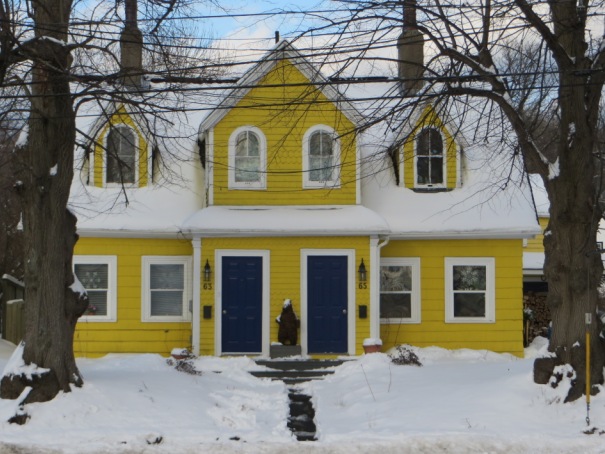
I had written about this yellow house for a post in January of 2014 entitled Remedies for Winter Blues, and this is the second time I’ve been unable to dismiss an earlier Weekly Photo Challenge from my mind, succumbing, at last, to “dealing with it” in my own belated way. You guessed it! The theme for the assignment that I missed weeks ago, in December, was “Yellow”, and there’s no denying that this image fulfills that criteria. To learn more about why I first chose to describe this home across the street from where I live, please read my earlier entry, and tell me what you think. (The black bear standing on its hind legs–a sculpture positioned between the two marine blue doors of the duplex–holds a basket filled with flowers in its front paws during the summer months. It gave me a scare when I first noticed it as night was falling, but I appreciate the zany sense of humour expressed by the wonderful couple who own the building.)
The Yellow House (Weekly Photo Challenge: Yellow)
Gone, But Not Forgotten (Weekly Photo Challenge)
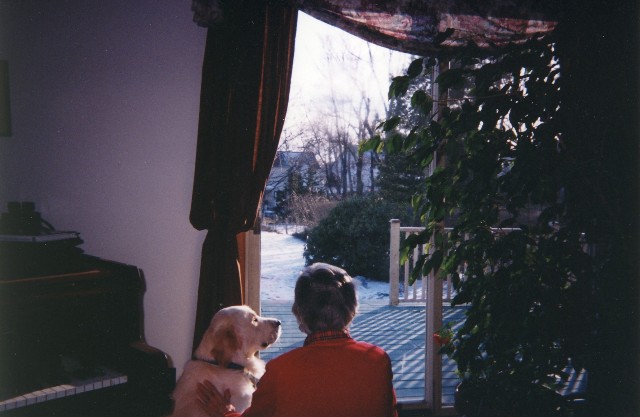
This photograph was taken a decade or so ago, before it became necessary for Betty–my mom–to move to a senior’s care residence, and before our beloved pet “Bud” passed away from complications of hemophilia within two and a half years of her death. This image came to mind when I first saw the weekly challenge on this theme in early December. Over the intervening weeks, prior to my decision to post their photograph, I have experienced such warm memories of them both that I could not help but share their love with you, as they gently cared for one another, and for all our family. Gone, but not forgotten. Ever.
The Face in the Window (Photo 101: Glass)
I was standing across the street from Flight of Fancy: Fine Art Hand Crafts in Bear River, Nova Scotia one summer afternoon a few years ago, when I had the uncomfortable feeling that my husband and I were being secretly spied upon by a stranger. Intuition, perhaps, made me glance up at a second story window of the gallery, and I was relieved to find that there was, indeed, a mysterious but non-threatening figure staring out through the pane of glass.
One morning in early spring, I rescued these iris blossoms from where they’d fallen to the ground during a stormy night. I love how the velvet-textured, purple hues of the standards and falls were intensified by the natural light shining through both them and the vase in which they stood on the windowsill. The swirling cobalt ribbon of colour in the glass along with the deep blue starfish and a small dish nearby, further added to my pleasure in the scene. Even the showers outside my kitchen window were unable to dampen my mood that day!
Reflections 2: Self-Editing
These reflections of the mirror-image variety prompted me to consider those of a different nature, which I mused about on this site a few years ago. In an earlier post, I had described my delight in playing with words. Similarly, photographs may occasionally capture my imagination to the extent that I can’t help but “play” with them, too.
When, for example, I viewed the first of the above smaller pictures on my computer screen, I immediately thought of a perfectly symmetrical, cultivated Christmas tree lying curbside after the holidays. I decided to rotate the image, making the “tree” appear vertical, just for the fun of it. Could our friends have been paddling up its trunk, or had they been hanging there, like blue and red baubles attached by the same white, satin ribbon? In the last of the images, fallen branches reflected by the surface of the water reminded me of a dream catcher; and in the photo above it, I immediately saw a giant squid. Could those be tentacles flowing out behind the creature swimming past?
These thoughts carry me back to the process of self-editing. Instead of dreading the work involved, perhaps I should give myself permission to be playful; perhaps I should revise chapters of a manuscript in order of last to first; perhaps I should change the size and type of the font I’ve been using or the “working title” or the names of the characters; perhaps then, I would see my writing with fresh eyes, making me aware of whole new creative possibilities.
17 Words That Together, Speak Volumes
“Be / As a page that aches for a word / Which speaks on a theme that is timeless…”
© 1973 Neil Diamond, Lyrics from the movie soundtrack Jonathan Livingston Seagull.
So often, as writers, we struggle to fill blank pages with words that when taken all together–in their final and edited arrangement–will be meaningful to readers, and that will somehow, in some way, move them to a deeper understanding of themselves, their relationships, their appreciation of nature, their understanding of suffering and so much more. Recently, while listening to the soundtrack of Jonathan Livingstone Seagull for the first time in many, many years, the words I have quoted above touched me in a way that I’d not experienced before, even though I’d played the album over and over again in the ’70s when I was in awe of both the Voice and the lyrics of the singer. (That capital V was intentional!)
Coming to these words again, after writing fiction for many years, I now envy Diamond’s poetic and succinct expression of the deeply felt emotions that one may experience in relationship to the blank page, for he chose to equate it with each one of us and our yearning, or spiritual longing, to infuse whatever we place there with infinite and universal meaning. There have been many times when I, too, have ached “for a word, which speaks on a theme that is timeless….” I’m sure I’m not the only one who has felt this way. You, too?
Remedies for Winter Blues
I’ve never particularly liked the winter season, and in fact, I’ve always been one of those people who dread its arrival every year as the daylight hours become fewer in number. Yet when I observe a duvet of pure white snow blanketing the neighbourhood, with gusts of wind tucking it up around the foundations of every home, I can’t help but pause and enjoy the beauty of it. On another day, my attention may turn to the mist rising from the harbour, or to one of several vignettes making up the landscape beyond my windows.
I remember my initial shock when the owners of a Victorian era duplex located across the busy road from our home, painted it a bright, daffodil yellow. I wondered how I would ever get used to the sight of it, since it had the same effect on me as if a flashbulb had gone off a few inches from my face. The next spring, these same neighbours, brushes in hand, covered their front doors in an ultramarine blue.
Each year after that brought more small changes to the property opposite ours. Then last summer, a red lacquered, wooden chair appeared on the front step, and at the same time, the garden beds on either side bloomed with perennials, including spikes of blue delphiniums and red hollyhocks. What can I say? I was completely won over by the effect. Wow! I thought. A Van Gogh! Well, I may have been stretching the comparison more than a little, but the primary colours reminded me of Vincent van Gogh’s oil painting entitled “The Yellow House” (1888), in which the sky above the streetscape appears to be an expanse of cobalt blue, similar in shade to the doors mentioned above. This winter, after the first snowfall, the duplex not only exuded self-confidence, it also seemed defiant; no drab, gray day could possibly alter its sunny image. Ever. It struck me recently that the paint job I had first objected to, has since become a pure tonic for my winter blues!
There are other scenes, too, that have had an uplifting effect on my mood. The summer after the removal of our damaged crab apple tree, my husband and I replaced it with a disease resistant variety that bears “persistent” fruit. These have the appearance of large, crimson berries, and remain on the tree from fall through the following spring. We also planted two Pieris japonica “Mountain Fire” shrubs several years ago—one in front of each main floor window facing the sidewalk. The cultivar’s name describes them perfectly, since clusters of drooping, scarlet flower buds hang on evergreen branches all winter long, and new leaf growth in the spring is red, too. It’s amazing what a shot of colour will do to one’s morale on an otherwise dull day.
What else makes me happy at this time of year? Blue jays perform their daily antics in the silver-tipped branches of our magnolia tree, and chickadees hop among the dried berries of the Engelmann’s Virginia creeper vine beside the deck. When I spotted a red cardinal in early January, and soon after, a pair of fat robins sitting in the Viburnum nearby, I realized that I should never take anything in life for granted, but appreciate the small moments of joy that make up my day. [Check out my On Gardening menu tab for a description of this wonderful shrub–Viburnum x bodnantense “Dawn”, also known as arrowwood.]
- Pieris japonica “Mountain Fire”
- Twilight
- Winter Sky
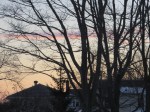
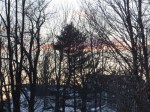
Like me, you may have noticed that sunsets can be spectacular in the winter months. The rose-coloured sky provides a canvas against which leafless trees appear to lean, their trunks and limbs looking as if they were lacy cut-outs made of black Bristol board. Surprisingly, it is in these months that the following lines resonate with me the most:
“I think that I shall never see / A poem lovely as a tree…”—Joyce Kilmer (Trees, 1914)
The stark silhouettes of barren trees taking shape at twilight attest to the truth of this poet’s words. One night–or should I say morning–I awoke at 4:30 a.m. and looked outside to see clouds racing across the sky like a stampede of wild stallions illuminated by the moon. I wanted to capture them permanently, but the slideshow below is unable to convey the speed at which they were travelling, and unfortunately, the images taken with my camera are not as sharp as they should be. During the time I was watching, the trees in our backyard became visible again, developing slowly, much like the details of a chemically infused Polaroid print (an analogy for those of you who might remember such a gadget in the days long before digital photography). If you have insomnia, as I sometimes do, get up and check out the night sky. You might be surprised by what you see, and at the same time, find your own remedy for winter blues.
Reflections
I awoke this morning intending to write a reflection on a topic that is often in my thoughts, but try as I might, I was unable to find words that would adequately express what is in my heart: there are not enough of them to describe the despair I often feel when I witness “man’s inhumanity to man” brought to us “live” on TV, or the sadness I feel when I hear of a friend’s fear-inducing medical diagnoses, or the helplessness I feel at the sight of devastation caused by tsunami, tornadoes and floods… There are so many more soul-crushing events that I could add to this list, but I know I don’t need to spell them out for you because you have your own.
With all the remarkable advances made in the twenty and twenty-first centuries involving cross-cultural understanding, religious tolerance, economic interdependency, scientific and health research, co-operative space research and climate change research, why are bloodshed, hatred and resentment still fueling wars in this day and age? I repeat the question time and time again, but the answers continue to elude me. If philosophers, scholars, theologians and others–of the few that I’ve read–have been unable to answer this question in a way that completely satisfies me on an emotional, intellectual and spiritual level, then how can I possibly attempt to do that myself! I can’t.
It’s often said that the worst situations bring out the very best in people, but I would like to think that kindness, generosity and altruism exist on their own–no painful prerequisite sharing of sorrows required to illicit them. The “good news” stories may not dominate what we hear and read about in the media on a daily basis, but they’re out there. Years ago, my mother’s engagement diamond escaped its setting and disappeared, with the dishwater, down the drain; it was later recovered from the trap. Like her diamond, each ordinary example of people caring for each other, helping each other through all manner of setbacks, needs to be retrieved, polished and held up to the light. Many people are doing that already, spreading positive messages about their families, neighbours and communities at a grassroots level, some using social media sites. If we are able to do that—to focus on what is beautiful about each other and in nature—then we will have hope, and therefore be more open to receiving and recognizing moments of unexpected grace.
The following reflections of the mirror image variety are ones that I captured with my camera in July 2013. They remind me of such moments. Perhaps the answer to Why? is simply Because! The beauty of these scenes flooded my whole being; I felt them; they spoke to me.
Solitude

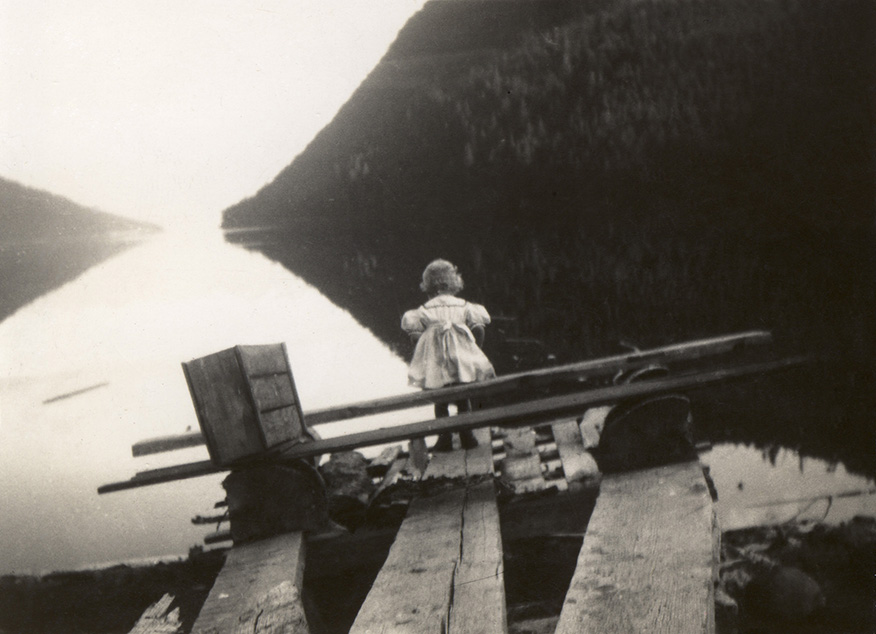
Beside my computer, on my desk, sits a small, framed photograph of a child wearing a blue and white seersucker dress with smocked bodice, embroidered pink flowers shirring the fabric bracketed by puffy sleeves. How is it possible that I remember the details of that dress, even though this picture—my only picture of it—was snapped in black and white!
Occasionally, when the stresses of everyday life seem too much to bear, I hold this image in the palm of my hand. I travel back in time to that makeshift bench of weathered boards beside the lake. I marvel, again, at the shaggy green of forested mountains stretching off to the horizon and rising steeply up on either side of the bay. I evoke the sweet smell of cedar. There—on my right—the Valhalla Range casts its self-portrait upon the surface of the water, brush-like strokes of emerald and jade reaching as far as the shallows near my feet. A pathway of shimmering sunlight on mirrored sky appears to beckon me towards a promising future.
Did I experience the solitude of nature, then, without being cognizant that I, like a golden eagle or a mountain goat, was an integral part of its weave? Perhaps I was simply watching minnows darting between the submerged planks of an unused boat launch. Or perhaps that particular moment in time was a defining one for me—the moment in which I began to grow aware of the vastness of the universe in contrast to my own small self. For whatever reason I was drawn there to sit, surely my soul was being fed and enriched.
Even today, this tranquil scene elicits a longing in me to protect and nurture the two-year old seated there, she who remains an intrinsic part of my identity.
Guyana Diaries
I have many wonderful memories of the fourteen months my husband Dennis and I lived in Guyana, and a few hair-raising ones, too. There was only one highway along the coast in 1967, and for the most part, it was flat and straight. Whenever we travelled to the capital city of Georgetown (a five hour trip, which in Canada would have taken an hour), we needed to be in front of the house at 4:30 a.m. to flag down a passing “hire car” that would drive us as far as New Amsterdam. From there, we would catch the ferry across the Berbice River. Then we boarded a train to take us the rest of the way to our destination.
Now for the hair-raising part! Considering the speed at which some of the drivers drove, it was as if they were taking part in a qualifying heat for the Grand Prix; the dangerous risks they sometimes took in passing each other on the road sent our blood-pressures soaring. While a wild ride was in progress, the stories of our fellow passengers, though somewhat entertaining, would often raise my level of anxiety. Perched on the edges of our seats, white-knuckled, Dennis and I would be forced to listen to snatches of conversation that would include references to a recent murder, or robbery, or home invasion. We were horrified, one day, when we saw the driver of the car ahead of us hit a cyclist. The impact sent the victim flying through the air, where he landed far from where it happened. The guilty car owner did not stop, nor did the man driving ours, despite our pleading.
Thankfully, the joy we experienced in getting to know our students, all eager to learn, meant much more to us than the few “hair-raising” events we remember. Although we were preparing them for the Cambridge University Entrance Exams, O Levels (I was teaching English Literature and Language; Dennis taught Science and Math), I tried to find extra books for them that were outside the strictly British-based curriculum, and in particular, novels and stories written by West Indian authors–ones that they could relate to in their day to day lives.
The enthusiasm of the kids for the books I found while on a shopping expedition to Georgetown, made the trips there worthwhile. These included several anthologies of literature written by Caribbean authors that were appropriate for Forms I-VI, and novels, by such well-known authors as V.S. Naipaul (originally from Trinidad; winner of the 2001 Nobel Prize in Literature), George Lamming (Barbados) and Andrew Salkey (Jamaica). On a trip to Mackenzie (now Linden) by speed boat up the Demerara River, we were thrilled to meet the Guyanese poet A.J. Seymour (1914-1990) while touring the Demerara Bauxite Mine where he had been working as a Public Relations Officer. (The company is now the Linden Mining Enterprise)
Seymour’s Name Poem may be found in the book Selected Poems / A.J. Seymour, and is a wonderful example of his appreciation for the origins of place names. Among those he mentions in his poem, are representatives of Amerindian (Kwebanna on the Waini); Dutch (Kykoveral, Stabroek); French (Le Ressouvenir and Le Repentir); English (Hid in Adventure, Bee Hive, Friendship); and Spanish (Santa Rosa). He ends his Name Poem with these words: “Beauty about us in the breathe [sic] of names,/ If but a wind blows, all their beauty wakes.” (38-39)
At that time, my favourite collection for kids in the 13-15 year old age range was entitled The Sun’s Eye: West Indian Writing for Young Readers compiled by Anne Walmsley (London : Longmans, Green and Co Ltd, 1968.) Occasionally I will pull it off my bookshelf and reread some of the stories and poems. Today I realize how dated the following poem by the late, Jamaican poet A.L. Hendriks may seem, yet I love the soft cadences of the lines within each verse:
An Old Jamaican Woman thinks about the Hereafter
by A.L. Hendriks
“What would I do forever in a big place, who
have lived all my life in a small island?
The same parish holds the cottage I was born in, all
my family, and the cool churchyard.
I have looked
up at stars from my front verandah and have been afraid
of their pathless distances. I have never flown
in the loud aircraft nor have I seen palaces,
so I would prefer not to be taken up high nor
rewarded with a large mansion.
I would like
to remain half-drowsing through an evening light
watching bamboo trees sway and ruffle for a valley-wind,
to remember old times, but not to live them again;
occasionally to have a good meal with no milk
nor honey for I don’t like them, and now and then to walk
by the grey sea-beach with two old dogs and watch
men bring up their boats from the water.
For all this,
for my hope of heaven, I am willing to forgive my debtors
and to love my neighbour…
although the wretch throws stones
at my white rooster and makes too much noise in her damn
backyard.” (Lines 1-24)